

The course aims to enable students to
◦ be able to manage PostgreSQL databases using database management client applications on their own
◦ learn the use of the SQL language
◦ be able to recognize the problems, that occur while using database management tools
◦ to be able to create databases, upload and query data on their own
Learning outcomes, competences: the student
Knowledge:
- learns to use the PostgreSQL database management system
Ability:
- is able to manage databases using various database management client applications
Attitude:
- works in an environmentally aware way, favouring electronic storage and management methods, and develops
independent learning skills
Autonomy and responsibility:
- continuously develops his/her IT skills and knowledge, expands his knowledge in the field of databases and develops his self-checking skills
Course content, topics
SQL basics
PostgresSQL database management system
Database client applications: Linux command line, R, Perl, QGIS, Web applications (Adminer, PhpPgadmin,..)
Managing biological databases
Intended learning activities, teaching methods
Manage databases in a guided and autonomous way. Weekly homework assignments, in-class supervision and
consultation.
Evaluation
To receive a grade, attendance in class and submission of homework assignments by the deadline in moodle is
required.
Practical exam.
- Oktató: Dr. Bán Miklós

- Oktató: Dr. Barta Zoltán
- Oktató: Dr. Jordán Sándor
The course aims to enable students to
- be able to collect data with GPS devices,
- be able to display, transform and analyse geospatial data.
- master the use of QGIS
- gain practice in the use of basic R geospatial packages.
Learning outcomes, competences: the student
Knowledge:
- Knowledge of the basics of remote sensing and geospatial computing, knowledge of the use of open-source geospatial tools
Skills:
- Ability to solve geospatial problems independently, analyse geospatial data
Attitude:
- commitment to quality work
- works in an environmentally responsible way, prefers electronic data storage and management methods, develops self-learning skills;
Autonomy and responsibility:
- Continuously develops his/her skills and knowledge in the field of geographic information technology.
Course content and topics
- Use of GPS devices: from handheld GPS to super precision devices - field exercises
- Aerial photography: raster analysis, aerial vs orthophoto: drone use and drone data in practice and theory
- QGIS
- R Geospatial Informatics
- Database and Geospatial Informatics
- Geospatial data and geospatial modeling
- Web Geospatial Informatics
- Oktató: Dr. Bán Miklós
- Oktató: Dr. Szabó Gergely

The course aims to enable students to
◦ learn the repeatable methods of image and video processing used in scientific research
Learning outcomes, competences: the student
Knowledge:
- is familiar with the most important open-source image and video processing tools
Ability:
- is able to process images and video on his/her own
- is able to process images and video in a repeatable and well documented way
- is able to plan an effective way to collect analysable data
Attitude:
- works in an environmentally aware way, favouring electronic storage and management methods, and develops independent learning skills
- strive to develop problem-solving skills
Autonomy and responsibility:
- has the necessary autonomy to prepare the data analysis phase of research projects.
Course content, topics
- Image processing automatisation with command line tools:
- ImageMagick,
- VLC,
- Mplayer,
- ImageJ,
- ffmpeg
- Video analysis tools:
- Mwrap,
- Tractor,
- Boris,
- idTracker
- Python OpenCV
Evaluation
◦ To receive a grade, attendance in class and submission of homework assignments by the deadline in moodle is required.
◦ Practical exams.
- Oktató: Dr. Bán Miklós
- Oktató: Oláh Gergő
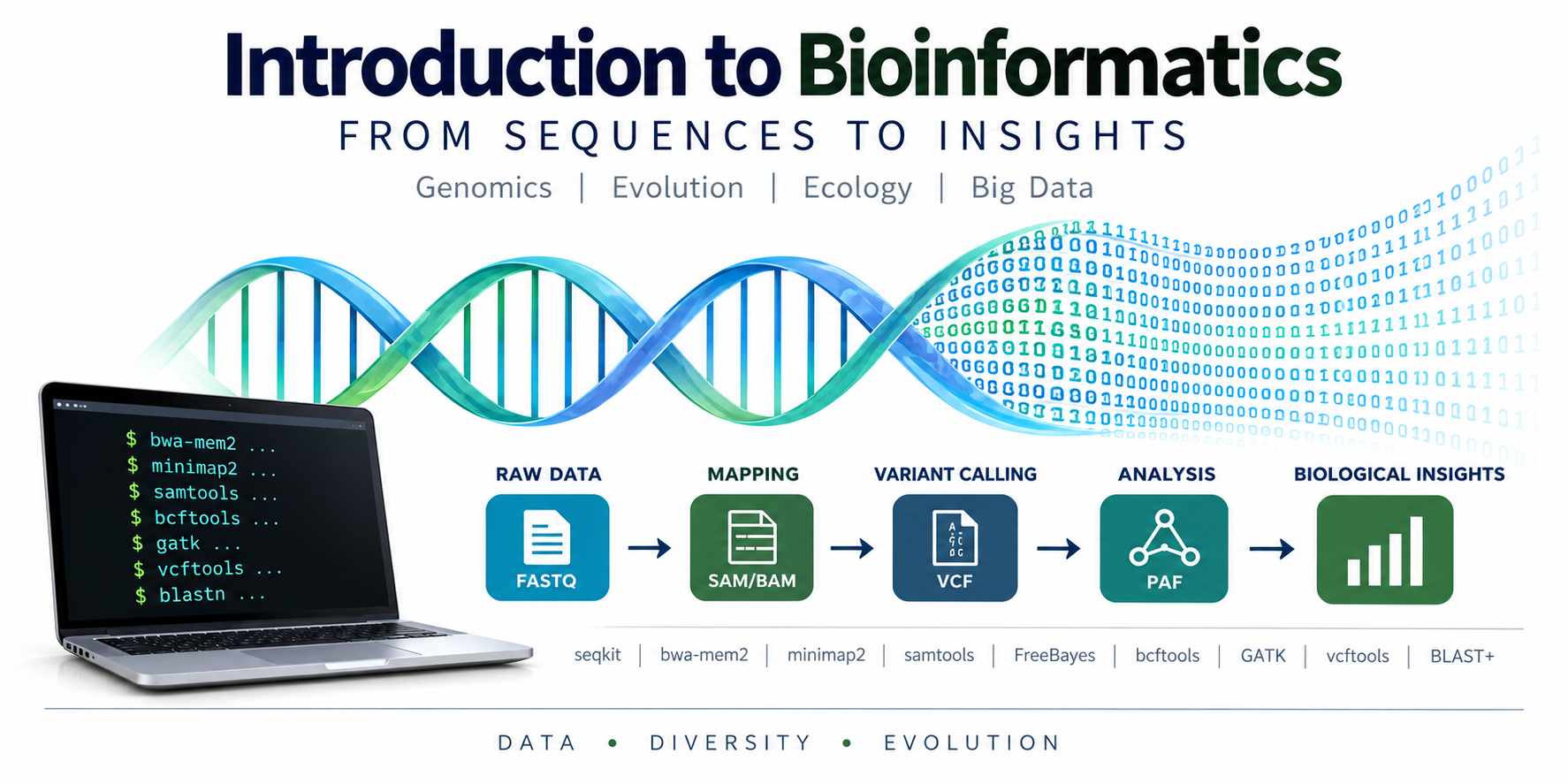
The course provides an introduction to bioinformatics with particular emphasis on its applications in evolutionary genomics, ecology and population genetics. Students are introduced to major types of genomic data, including whole-genome resequencing, transcriptomic and reduced-representation datasets, as well as the principles of reference genomes and sequencing reads. The course covers essential bioinformatic file formats and workflows, including FASTA/FASTQ, SAM/BAM, VCF and PAF, together with sequence mapping, variant calling, variant filtering and sequence similarity searches. Practical exercises introduce commonly used command-line tools such as Linux utilities, seqkit, bwa-mem2, minimap2, samtools, FreeBayes, bcftools, GATK, vcftools and BLAST+. Emphasis is placed on understanding the biological and computational principles behind genomic data processing rather than on software use alone.
- Oktató: Dr. Bán Miklós
- Oktató: Dr. Barta Zoltán
- Oktató: Dr. Sramkó Gábor

The course aims to enable students to
- Be able to work independently in a Linux command line environment
- Be able to solve text processing problems in a command line environment
Learning outcomes, competences: the student
Knowledge:
- Learns about the Linux operating system and is able to use basic Linux tools in practice
Ability:
- Is able to work independently in a Linux environment
Attitude:
- works in an environmentally aware way, favouring electronic storage and management methods, and develops independent learning skills
- is committed to quality work
- strives to develop problem-solving skills
- is open to new biological and other scientific research findings
Autonomy and responsibility:
- Continuously develops his/her IT skills and knowledge, and has the necessary autonomy to prepare the data analysis phase of research projects.
Course content, topics:
- Filesystem: ls, find, cat, vi, joe
- Processes: bg, fg, top, ps
- Network basics: ssh, scp, screen
- Text processing: grep, sed, | ,awk, tr, cut
- Regular expressions
- Bash programming
Milestones:
- Basic usage of Linux terminal. Creating and edit files, folders. Navigate in the file system.
- Log in to remote terminal, transfer files between remote and local place.
- Search and filter text files using grep, sed, awk
- Piping commands (grep, ls, sed, cat, cut, tr) to process text files
- Using regular expression in sed and awk
- Applying loop commands, functions to solve complex command line tasks
Assessment
During lessons, students are asked questions and may also formulate their own questions. 1 mark may be awarded on a per-occasion basis for assessable questions and answers containing substantive professional content. Simple, trivial answers or those requiring no particular problem-solving or professional justification cannot, in themselves, be awarded marks.
If the answer is not a simple verbal response, students may demonstrate their solution by sharing their computer screen.
The use of AI tools is permitted when formulating answers or solving tasks, provided that the question (prompt) posed to the AI is also presented. In such cases, the assessment will also take into account how accurately and appropriately the student was able to formulate their question, and how well they can interpret and verify the answer provided by the AI.
Every student must complete all milestones. To complete a milestone, a student must score at least 3 points.
- Oktató: Dr. Bán Miklós
- Oktató: Dr. Barta Attila


The course aims to enable students to
- be able to apply algorithmic thinking methodology to solve problems.
- master the Python programming language and object-oriented programming.
- gain practice in program development in Python through a significant amount of classroom and homework.
- recognize problems that can be algorithmised and be able to implement them in Python
Learning outcomes and competences: the student will
Knowledge:
- Be familiar with the elements of the Python programming language and apply them in practice for program development.
Ability:
- Be able to formulate problems algorithmically and to implement algorithms efficiently in Python.
Attitude:
- Strives to develop problem-solving skills,
- work in an environmentally aware way, prefer electronic data storage and management methods, develop independent learning skills;
Autonomy and responsibility:
- Continuously develops his/her skills in the field of programming and self-monitoring.
Course content and topics
- Steps to develop a program in Python. Types of errors, syntactic and semantic errors and how to avoid them.
- Python program structure, structured programming.
- Data and variables. Data types. Instructions, loops.
- Functions. Files.
- Data structures: strings, lists, dictionaries.
- Classes, objects, inheritance.
- Exception handling.
- Oktató: Ecsedi Kornél
- Oktató: Oláh Gergő

A kurzus célja, hogy a hallgatók
- ismerjék és alkalmazni tudják az R statisztikai környezetet
- ismerjék és használni tudják az alapvető kísérlettervezési és adatkezelési eljárásokat
- el tudjanak végezni és értelmezni tudjanak egyszerű statisztikai próbákat
- ismerjék és alkalmazni tudják az egyszerű többváltozós elemzési módszereket.
Tanulás eredmények, kompetenciák: a hallgató
Tudás:
- ismeri a fontosabb statisztikai fogalmakat, statisztikai próbákat, többváltozós statisztikai módszereket és ezek alkalmazhatósági feltételeit
Képesség:
- képes egyszerű tudományos projektek adagyűjtését megtervezni
- képes az adatait a statisztikai elemzésekhez előkészíteni, illetve képes mások adatait értelmezni és kezelni
- képes egyszerű statisztikai eljárások elvégzésére
- képes egyszerű statisztikai eljárások értelmezésére
Attitűd:
- elkötelezett a minőségi munkavégzés iránt
- törekszik problémamegoldó-képességének fejlesztésére
- nyitott az új biológiai és más természettudományos kutatási eredmények megismerésére
Autonómia és felelősség:
- rendelkezik kutatási projektek adatelemzési fázisának elvégzéséhez szükséges önállósággal
A kurzus tartalma, témakörei
-
Bevezető
az R statisztikai környezet használatába.
- Adatkezelési
alapfogalmak.
- Leíró statisztika.
- Statisztikai hipotézisvizsgálat.
- Átlagokra vonatkozó statisztikai próbák.
- Nem-parametrikus próbák.
- Varianciákra és eloszlásokra vonatkozó statisztikai próbák.
- Varianciaanalízis.
- Folytonos változók kapcsolatainak vizsgálata.
- Lineáris regresszió és korrelációszámolás.
- Kovarianciaanalízis.
- Többváltozós statisztikai modellek.
- Modellszelekciós eljárások.
- Lineáris statisztikai modellek
alkalmazhatósági feltételei.
- Általánosított lineáris modellek.
- Kevert lineáris modellek.
- Főkomponens-analízis.
- Oktató: Tökölyi Jácint

The course aims to enable students to
◦ get to know the web techniques necessary for scientific work
◦ be able use WEB APIs
◦ get to know web research tools
Learning outcomes, competences: the student
Knowledge:
- is familiar with the use of web applications used by biologists
Ability:
- is able to use the web applications needed for scientific researches on his/her own
Attitude:
- strives to develop problem-solving skills;
- works in an environmentally aware way, favouring electronic storage and management methods, and develops independent learning skills
Autonomy and responsibility:
- continuously develops his/her IT skills and knowledge and develops his/her self-checking skills
Course content, topics
- Network basics (internet, rooters, DNS, SSL, ports)
- Web (HTTP, HTTPS, POST, GET, ...)
- Wget
- Curl
- JSON
- JQ
- API in practice:
- GBiF
- iNaturalist
- Nasa
- Geoss
- OpenBioMaps
- National Weather Service
- weather services
- air quality
Evaluation
◦ To receive a grade, attendance in class and submission of homework assignments by the deadline in moodle is required.
◦ Practical exams.
- Oktató: Dr. Bán Miklós
